
Report
How Forecasting Models Improve Media Investment Decisions
How CFOs and procurement teams can use precise net investment data, modeling, and standardized tenders to prevent overspending and improve the return on every euro invested.
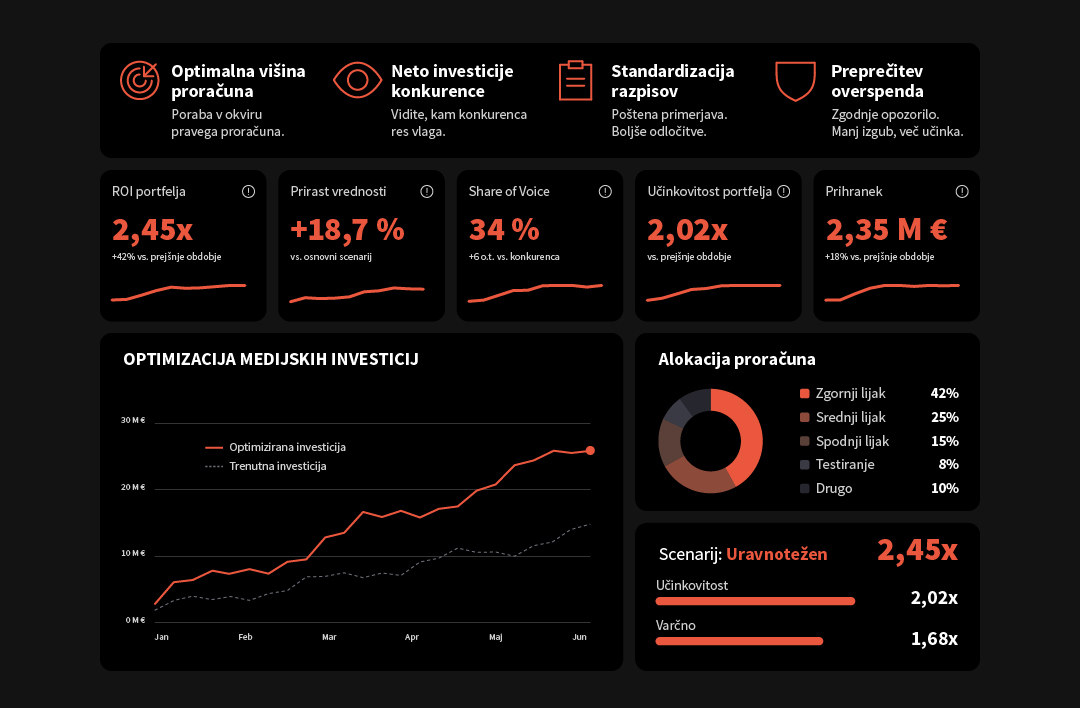
For most large companies, advertising ranks among the TOP 3 largest operating expenses (OPEX). Yet media investment remains one of the few areas where investment decisions are often based on historical habits, intuition, incomplete agency assessments, or subjective judgments.
For Chief Financial Officers (CFOs) and Procurement teams, this creates a serious risk: information asymmetry and the risk of overspending.
So how can science and data determine the appropriate level of media investment, and why is precise insight into net investments across the category and among competitors the only way to protect the company’s capital?
1. Scientific Foundation: Why Can Overspending or Underspending Occur?
There are two key concepts in media economics and marketing science that every CFO and procurement professional should understand:
A) The ESOV Rule (Excess Share of Voice)
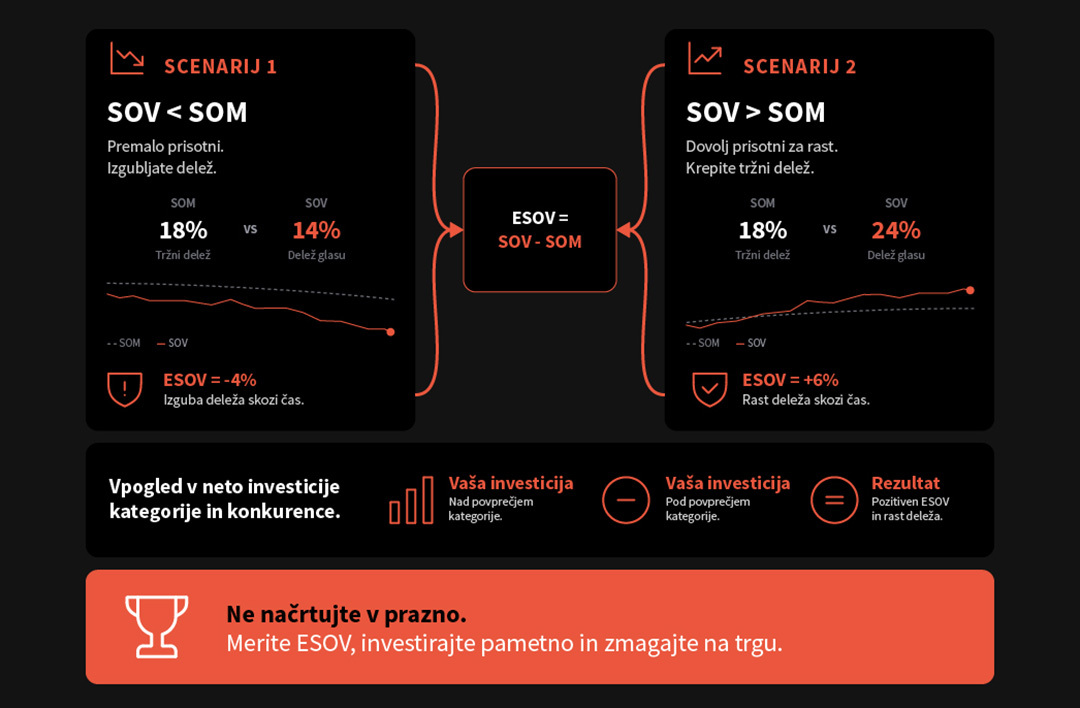
Renowned media effectiveness researchers Les Binet and Peter Field (IPA), together with research organizations such as Nielsen, have demonstrated through decades of analysis a direct relationship between market share (Share of Market – SOM) and advertising share of voice (Share of Voice – SOV).
If a company and its brand want to grow or defend their market position, their SOV must be higher than their SOM (known as Excess Share of Voice).
The challenge for procurement: If you do not know the exact net investments of the entire category and your direct competitors, you are effectively planning in the dark. If you invest too little, you risk losing market share. If you invest significantly beyond the saturation point, you create pure media waste (overspend).
B) Zakon padajočih donosov (S-krivulja & Adstock efekt)
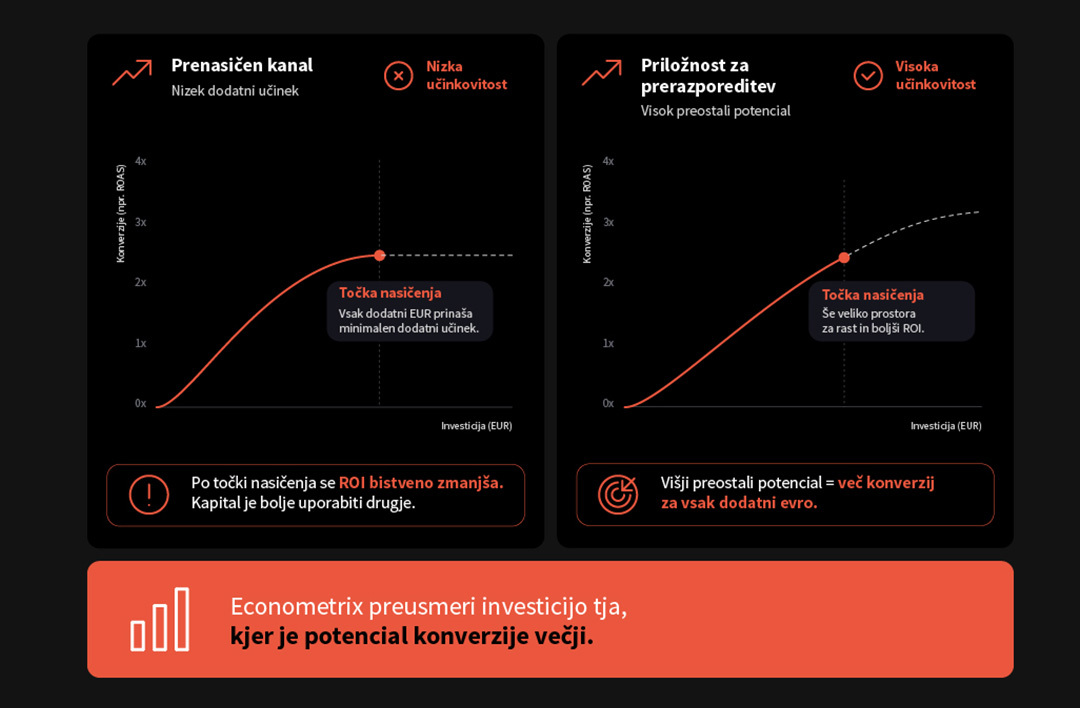
Every media channel has its own mathematical saturation point. Once the budget allocated to a particular channel exceeds this point, each additional euro invested generates a lower return in sales. Without econometric modeling, companies often “burn” their budgets on channels that have long since exceeded their saturation point, while neglecting channels with high affinity.
2. The Procurement Trap: Why Is the “Cheapest GRP or Click” Often the Most Expensive in Practice?
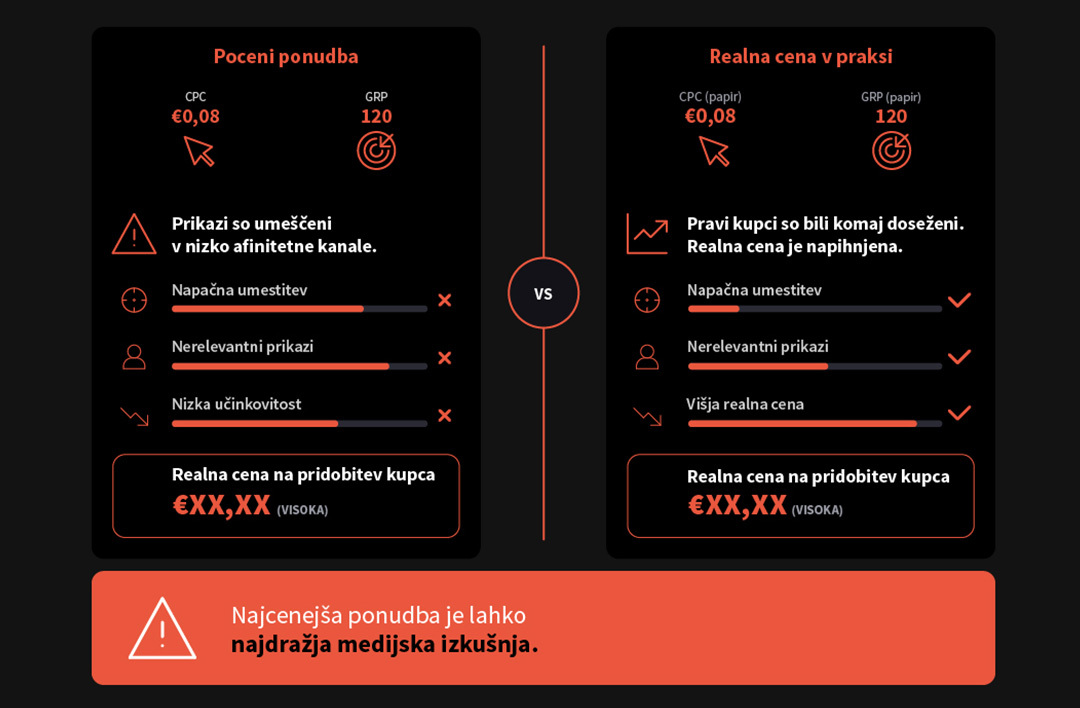
Traditional procurement processes in media tenders often fall into the trap of linear price optimization: selecting the provider (agency or media company) that offers the lowest cost per click (CPC) or the lowest cost per TV rating point (Cost per GRP).
However, the media market works differently from the procurement of raw materials:
A low cost per GRP or click can mean poor placement: An agency may deliver enormous reach at an exceptionally low price, but place the ads on the “wrong” or cheaper channels and media outlets, or on websites with low purchase affinity.
The result: Although the metrics may look attractive on paper, your target audience does not see the ads. All these irrelevant impressions and ad placements artificially increase the real cost of reaching the small proportion of customers who actually saw the ad and are genuinely willing to buy your product or service. What appears to be the cheapest offer can therefore become the most expensive in practice—because you are paying for impressions that deliver no value.
3. The Solution: Precise Investment Planning and Standardization of Media Tenders and Investments with Econometrix
For CFOs and procurement teams to eliminate risky guesswork and gain greater control over media budgets, they need a neutral, data-driven tool. Knowing the exact level of investment—both your own and that of your competitors—is essential not only when selecting agency partners and media outlets, but also as the foundation for strategic advertising investment planning.
Econometrix bridges the gap between finance, procurement, marketing, and media agencies/media companies:
Precise investment levels for budget planning: Instead of setting annual investments based on “last year’s figures + X%” or broad estimates, Econometrix calculates the precise level of investment that is optimal across channels and media outlets and required to achieve your objectives within the competitive landscape. This enables predictable investment instead of guesswork, as well as immediate strategy adjustments when budgets are reduced or business objectives change.
Insight into competitors’ and category-wide net investments: Econometrix provides precise insight into investment levels across the entire category and among direct competitors. Knowing the exact level of competitive investment in the market prevents overspending while also protecting the company against underinvestment in key products and services.
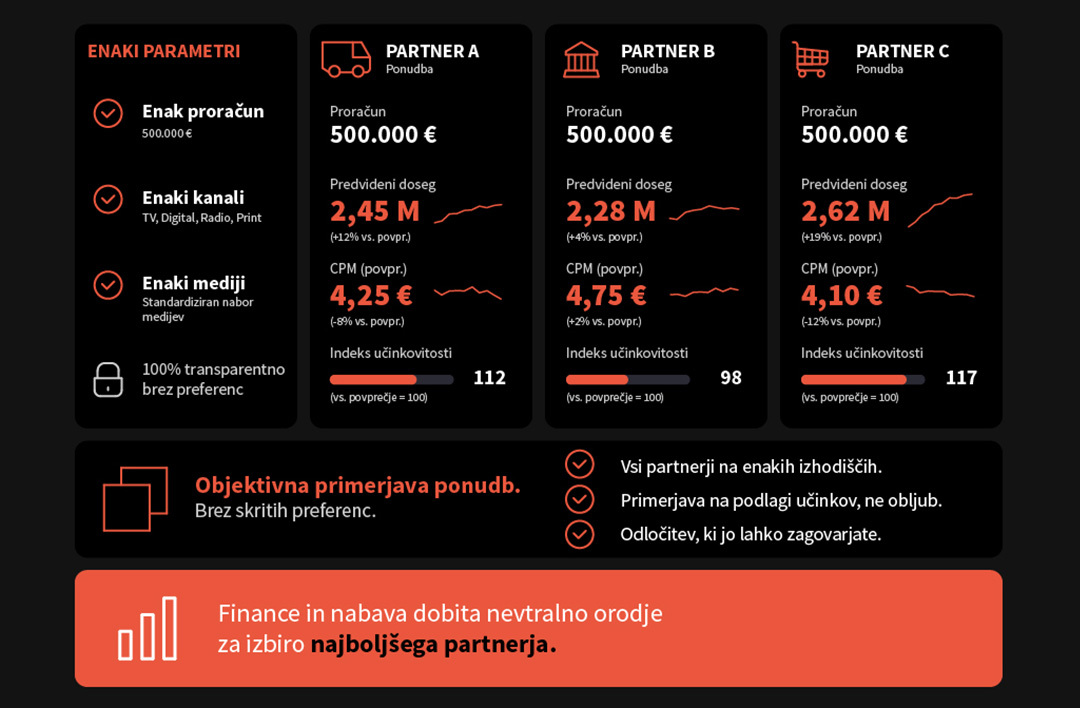
A neutral tool for preparing media tenders and briefs: When preparing new media tenders or annual briefs, require agencies and media companies to structure their proposals according to the investment allocation calculated by Econometrix. This eliminates personal preferences, undisclosed arrangements, and decisions based on subjective assessments rather than data.
Fully comparable proposals from all partners (Apples-to-Apples): All bidders prepare their proposals based on the same budgets, channels, and media outlets. Procurement can therefore select the most financially and strategically suitable partner with confidence.
The end of the Wanamaker myth: Forget the theory that 50% of media investment is wasted. By using econometric models and defining the media consumption patterns of your target audiences, you can eliminate less effective channels and direct investment precisely where you have the greatest potential for conversion.
Conclusion
Media investment management should not be left to intuition or incomparable agency proposals. By using Econometrix, finance and procurement teams gain a mathematical tool that ensures transparency, comparability, and maximum return on every euro invested.
Would you like to discover where opportunities for optimization and cost savings are hidden within your media investments?
I want a presentation